How Google Indexing Actually Works
Before diagnosing indexation problems, it helps to understand the three-stage process Google uses to include a page in search results. A breakdown at any of these stages results in a page that doesn't appear — and the fix depends entirely on where the breakdown is occurring.
How to Check If Your Pages Are Indexed
Before troubleshooting, confirm which pages are actually missing from Google's index. In Google Search Console, navigate to Pages → Why pages aren't indexed. This report categorises every URL Google has encountered and explains why it isn't indexed.
You can also type site:yourdomain.com into Google to see approximately how many pages are indexed, or use the URL Inspection Tool in Search Console to check the exact indexation status of any specific URL.
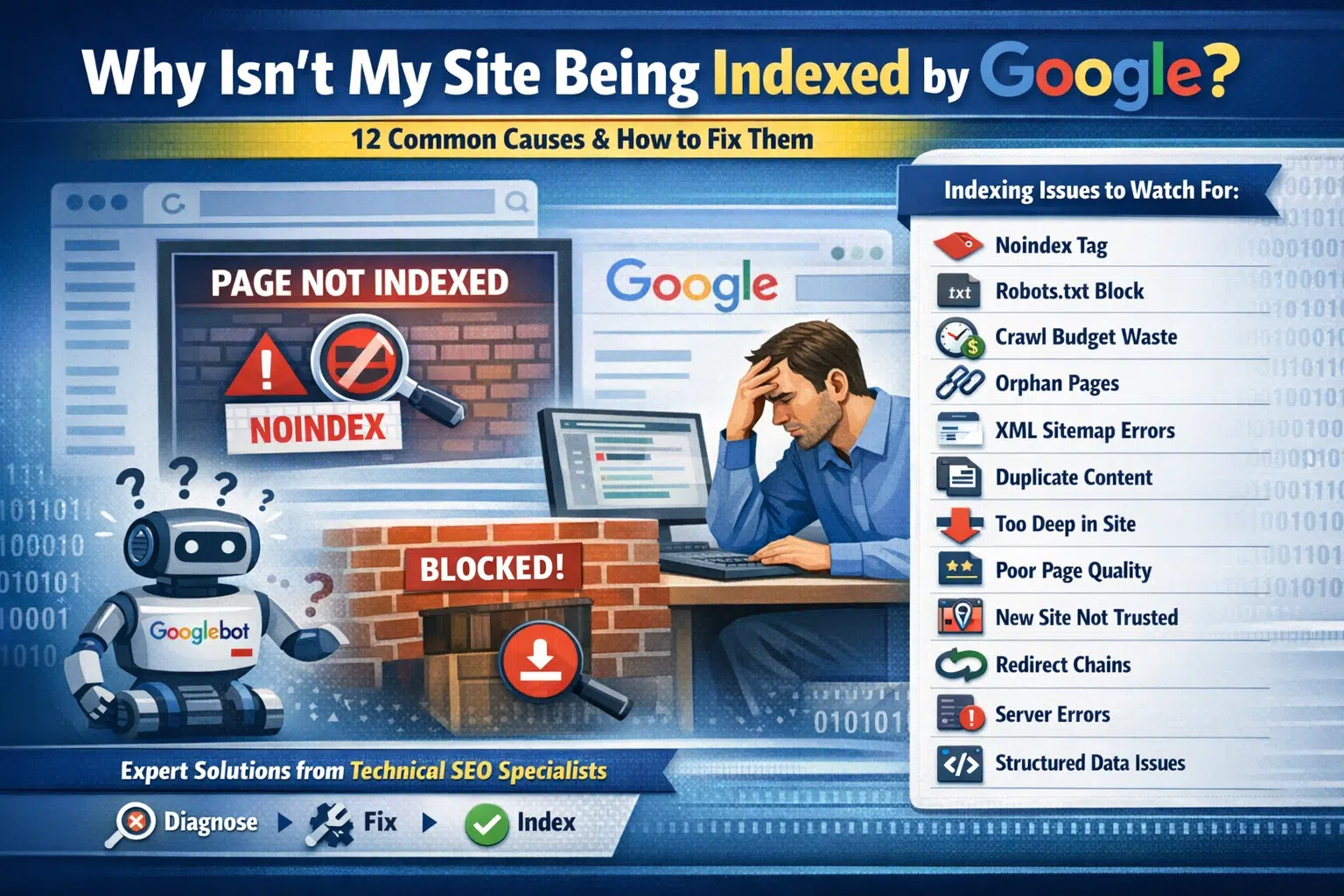
The 12 Most Common Reasons Google Isn't Indexing Your Site
The most common cause of indexation issues. A <meta name="robots" content="noindex"> tag explicitly tells Google not to index the page. Check your page source for this tag in the <head> section — it is frequently added during development and never removed before launch.
Your robots.txt file tells crawlers which pages they can access. Visit yourdomain.com/robots.txt and look for Disallow rules that might cover your important pages. Use Search Console's robots.txt tester to verify before making changes — a robots.txt block affects everything Googlebot does on your site.
Google allocates a limited number of crawls to each site per day. If that budget is consumed by low-value pages — parameter-based URLs, duplicate content, thin archive pages — your important pages may never get crawled. Pull a log file analysis to see exactly which pages Googlebot is visiting, then block low-value URL patterns in robots.txt and use canonical tags to consolidate duplicates.
Google discovers pages primarily by following links. If a page has no internal links pointing to it, Googlebot may never find it regardless of whether it's in your sitemap. Use a crawl tool to identify pages with zero internal links, then add contextually relevant links from established pages to orphaned content.
Your XML sitemap should be a clean list of indexable URLs. If it includes noindexed pages, redirected URLs, or pages returning errors, you're sending Google conflicting signals. Rebuild your sitemap to include only canonical, indexable URLs returning a 200 status code, and resubmit it in Search Console after cleanup.
If multiple URLs serve similar or identical content without canonical tags specifying which version Google should index, Google may index the wrong version — or none at all. Implement self-referencing canonical tags on all pages, and ensure that paginated, filtered, or parameter-based URLs either carry canonical tags or are blocked from indexation entirely.
Google generally crawls to a depth of 3–4 clicks from the homepage. Pages buried 5, 6, or 7 levels deep may be technically accessible but rarely crawled. Use a crawl tool to generate a crawl depth report, then restructure your navigation and internal linking to bring priority pages within 3 clicks of the homepage.
Google doesn't index every page it finds — it makes a quality judgment. Pages that are extremely thin, highly similar to other indexed pages, or provide no clear value to a user may be crawled but deliberately excluded. Review Crawled — currently not indexed pages in Search Console and substantially improve content quality, or merge thin pages into more comprehensive ones.
Google takes time to trust new domains. A brand new website may have its pages crawled but not indexed for weeks as Google evaluates the site's credibility. Build external links from established relevant websites, submit your sitemap, publish substantive original content consistently, and use internal linking from day one to help Googlebot map your site structure early.
If a page has been through multiple redirects — A to B to C to D — Googlebot may follow the first hop or two and then give up. Use a crawl tool to identify redirect chains and update all redirects to go directly to the final destination in a single hop. Also update internal links to point directly to the canonical URL.
If your server returns 5xx errors when Googlebot visits, it will retry later — but persistent server errors cause Google to reduce crawl frequency over time. Check Search Console's Coverage report for server errors and review your server logs for 5xx responses specifically to Googlebot's user agent, since general server monitoring often misses these.
While structured data errors don't directly block indexation, they send negative quality signals. Schema validation errors indicate to Google that the site's technical implementation may be unreliable. Use the Rich Results Test and review the Enhancement reports in Search Console for structured data errors, then resolve them with clean custom JSON-LD structured data.
The Right Order to Fix Indexation Issues
If you're dealing with multiple indexation problems at once, address them in this priority order — starting with anything that actively blocks access before moving to quality and architecture improvements:
Remediation Priority Order
Additional Resources
Pam Harper
Founder of Harper Media Group. 20+ years of web development, 12+ years of technical SEO. Specializing in technical SEO, structured data, and AI optimization — delivered white-label for agencies.
About Pam Harper